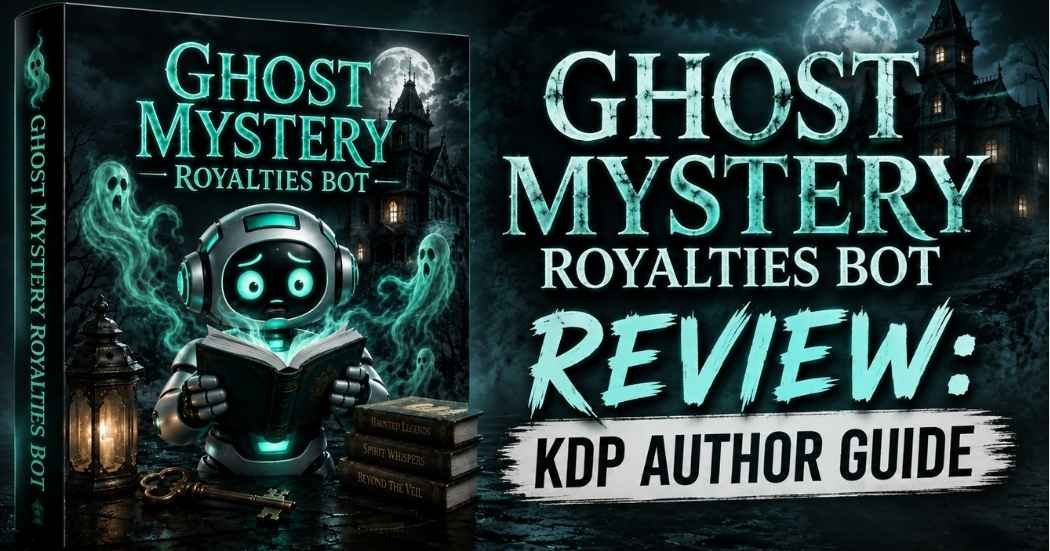
The easy thing is to write a ghost story. The part that most writers struggle with is making that idea a full mystery, developing a working story, maintaining the continuity of characters and clues, and making sure it pays off in the end. Add all of the things that Amazon KDP expects after—keys, a description that will convert browsers into buyers, a cover for the genre, and a solo author- and those weeks will pass before the first chapter is even written.
This Ghost Mystery Royalties Bot Review examines a Bot based on ChatGPT designed specifically for this predicament. Designed for authors who want to write ghost stories, paranormal stories, and mystery stories, but who don’t want to have an empty chat window and a vague idea.
This is a stand-alone summary of what the tool does, how it’s assembled, the cost (including the upsells), and its shortcomings. All of this is without hands-on test logs or claimed results. It’s created from the product’s documentation, read critically, and explained in simple words to determine if it matches your writing process.
Quick Verdict (TL;DR)
For the short version before getting into the details, here it is.
Ghost Mystery Royalties Bot is NOT a magic book writing machine; it is a niche AI writing workflow. It provides you with a framework to go from concept to a written document and a set of assets for your book on Kindle, but you must come to it and edit it.
- Best for: Authors specifically interested in ghost, paranormal, or supernatural mystery fiction
- Main strength: A staged workflow that turns “write a novel” into smaller, manageable steps
- Main weakness: The output still needs real editing before it’s publish-ready
- Price/value: $17.88 front-end price is low for the number of functions included
- Who should consider it: Beginners who want a roadmap, and experienced authors who want to speed up planning
- Overall verdict: A reasonable niche tool if you go in with realistic expectations about how much work is still yours
Product Overview
Before getting into each feature, here’s a snapshot of what the product covers.
Category | Details |
Product | Ghost Mystery Royalties Bot |
Main purpose | AI-assisted ghost and paranormal mystery book creation |
Target audience | Fiction authors and aspiring KDP publishers |
Platform/workflow | ChatGPT-based guided workflow |
Main features | Story planning, chapter drafting, KDP assets, keywords, description, cover, pen name |
Front-end price | $17.88 |
Niche | Ghost, paranormal, and mystery fiction |
What separates this from just typing a prompt into ChatGPT yourself is the sequencing. Instead of one giant instruction and hoping for a coherent 200-page novel, the process is broken into stages that build on each other, story first, publishing materials after.
What Is Ghost Mystery Royalties Bot?
Ghost Mystery Royalties Bot is a ChatGPT workflow geared towards a specific job: assisting authors with writing ghost and paranormal mystery stories and preparing them for Amazon KDP. Consider it more of a checklist ChatGPT helps you with, rather than a personality for a chatbot.
If you’ve never written with some help of AI before, it’s easy to see why it’s appealing. There’s no blank cursor staring at you for inspiration on what to type. Throughout the entire system, it asks you questions, takes your answers, and proceeds to the next stage: concept, characters, mystery, chapters, and finally the KDP part.
It’s not only the manuscript that goes beyond. The workflow can create back-end keyword suggestions, write a book description, come up with a cover concept, and even come up with a pen name if you wish to publish under one. It is that combination that is at the core of the product: writing and publishing preparation in one.
It is only when it comes to originality and judgment that it has real boundaries. It can help structure your thoughts and generate a first draft of every part of the story, but it can’t make decisions about what should actually be revealed, or what the actual character motivations are, or whether the pacing is right, or whether the character’s motivation rings true. This remains in your memory.
How Does It Work?
The workflow is not for creating a whole novel from a single prompt, but rather stages in the development of a book.
- Select the direction of the book. You first select the format and outline of the ghost story, and basically outline in your mind what kind of ghost or mystery story you’re looking for.
- Create a Story Bible. In this stage, this is fixed in the haunting, the investigator, the cast, the central mystery, and how it eventually gets solved.
- Plan the manuscript. The story is structured into chapters before any writing begins, so there is a plan available.
- Write chapter-wise. The manuscript is pieced together in one large generation, so that each section doesn’t get too large.
- Prepare KDP materials. After the manuscript is in progress, the system moves to the keywords of the book and a book description.
- Work on the cover and author identity. Finally, you can use the AI cover tool and the pen name or author persona feature.
At first sight the staged setup doesn’t seem to be all that significant. Long fiction projects are doomed to fail when there is no plan, and this means that you will have to plan before you begin to write, so you can see any potential problems before it gets to fifty pages of writing.
Who Is It For?
Designed for those who desire to write in the paranormal or mystery genre, but prefer to take an existing path instead of starting from the ground up.
It has the best potential for effectiveness with:
- New authors for KDP who would like a starting structure instead of a blank page.
- Fiction writers experimenting with ghost or paranormal stories for the first time.
- Plotters who have a problem with plotting or organizing a mystery story.
- Authors who don’t want to spend hours repeating the same tedious publishing process.
- Current authors who are seeking an AI ideation partner.
Romance, thriller, and sci-fi are not the genres that this tool is designed for, and if you are not one of those who want to write entirely without the help of AI, you might not be the target user here.
Key Features
Listed are the workflows and what they can be practically used for.
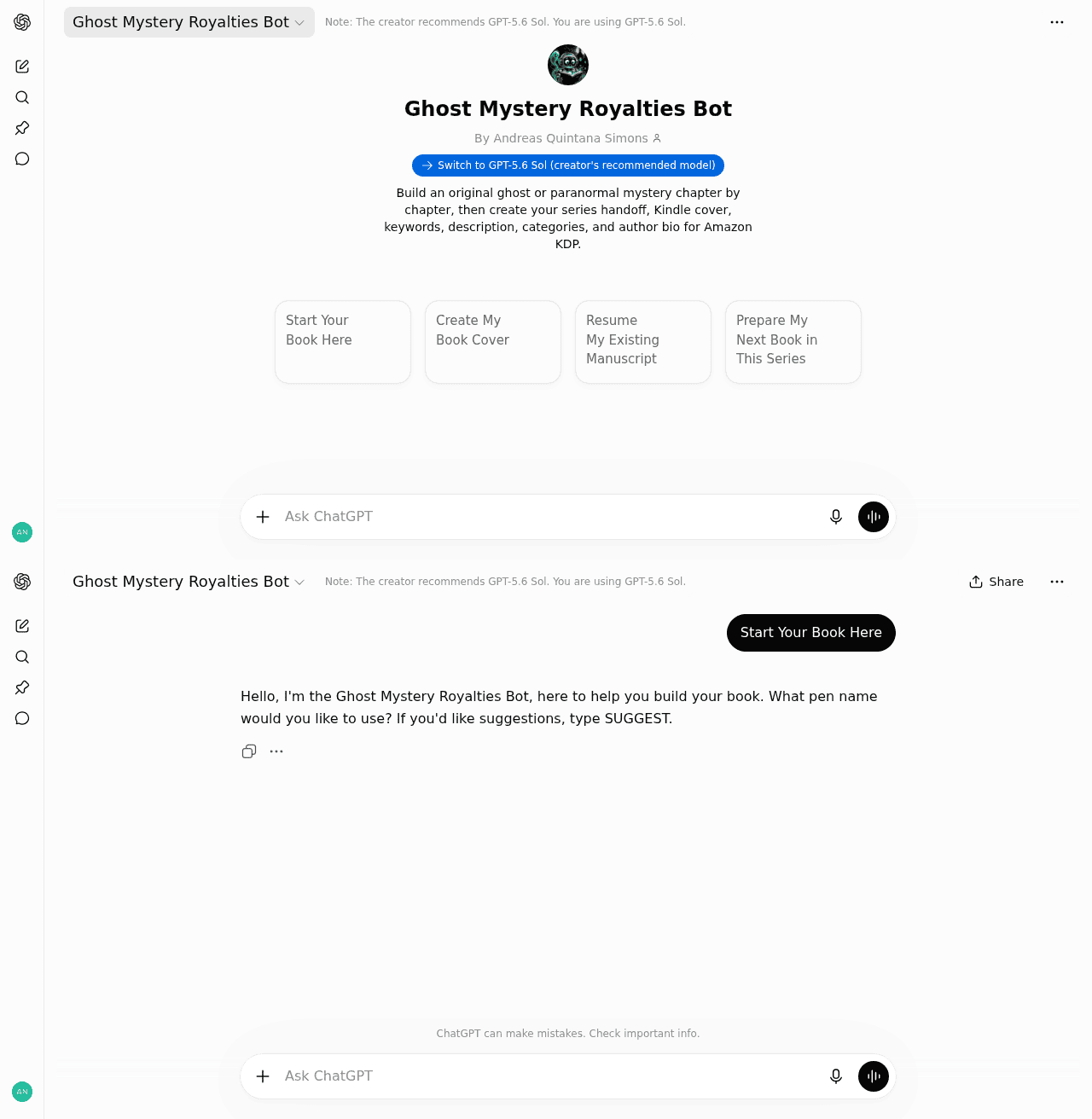

- Guided fiction workflow – Saves you the headache of having to work out the workflow yourself.
- Story Bible creation – Locks down the haunting, investigator, mystery, and reveal before writing the first chapter, helping to prevent plot holes.
- Chapter-by-chapter writing – Divides the book into smaller chunks that can be reviewed.
- KDP keyword generation – Generates 7 keyword ideas for the back end, which you can use to get your own search ideas going.
- Book description creation – Provides you with a template you can edit based on your book’s premise and genre to create a book description.
- AI cover generation – Generates a concept for the cover, which you can refine and build off of instead of creating from scratch.
- Pen name and author persona tools – Supplies tools for authors who write under a pen name to create a strong author identity.
All of these characteristics are not standalone. The essence of them is that they are linked together, so you don’t need to switch between 5 tools to complete one book project.
4-Phase Writing Workflow
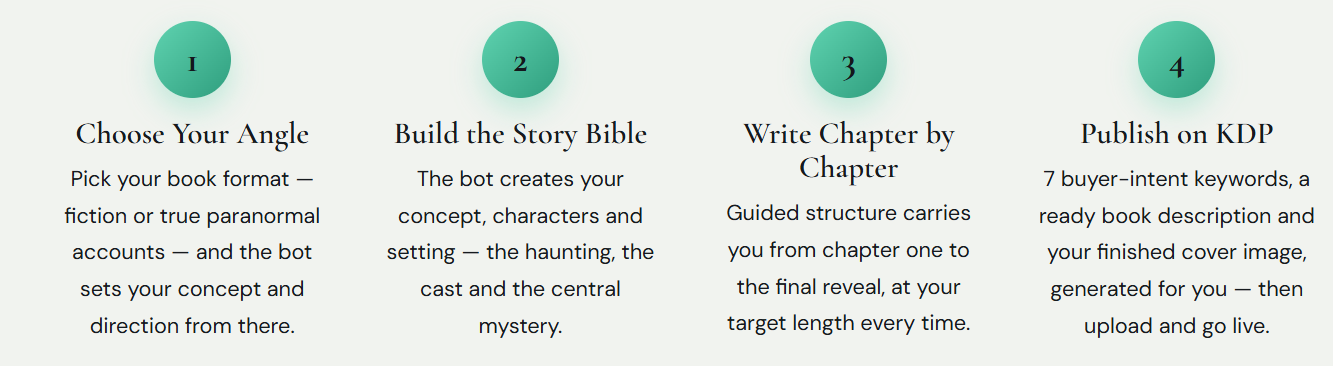
The entire process can be distilled into a series of four stages, and an understanding of each stage will help make sense of why the workflow is done in this manner.
- Format & Concept. This is where the project begins – this is the book you’re going to write and what it’s about. This is the right way to do it up front to save much of the redo work later.
- Story Bible. It is the foundation where the haunting, characters, investigator, and the eventual conclusion of the mystery are developed.
- Chapter-by-Chapter Drafting. Once the foundation has been laid, the manuscript is written, one section at a time, and a big project doesn’t seem so large.
- KDP Assets. The last part involves author branding, cover work, description, and keywords being published.
Combined, the four stages are logical: idea, planning, manuscript, publishing materials. That’s an interesting order to note because many AI fiction projects fail to plan things out, and these are the first steps that is.
Story Bible Creation
Mystery is a tough genre to be inconsistent with. With a dozen characters, planted clues, red herrings, and a reveal that must have some sort of connection, it won’t take long before you’re having trouble keeping all this in your head.
The Story Bible stage is designed to address just that issue. It focuses on the main elements of a paranormal mystery: the ghost itself, the investigator, the suspects, the central mystery, and finally the “Let’s Find Out!”.
The upside of this is consistency. Decisions made early will provide some sort of reference to use later instead of finding out that the backstory of a character doesn’t match up with chapter three halfway through the novel.
However, the AI-generated Story Bible is not just an end product when it’s created. But you still have to find out if there are any good reasons for the revelation, if the clues actually back up the reveal, and if the mystery doesn’t fall apart at the seams. That’s how plot holes creep in to the book and how a plot twist can get lost.
Chapter-by-Chapter Book Writing
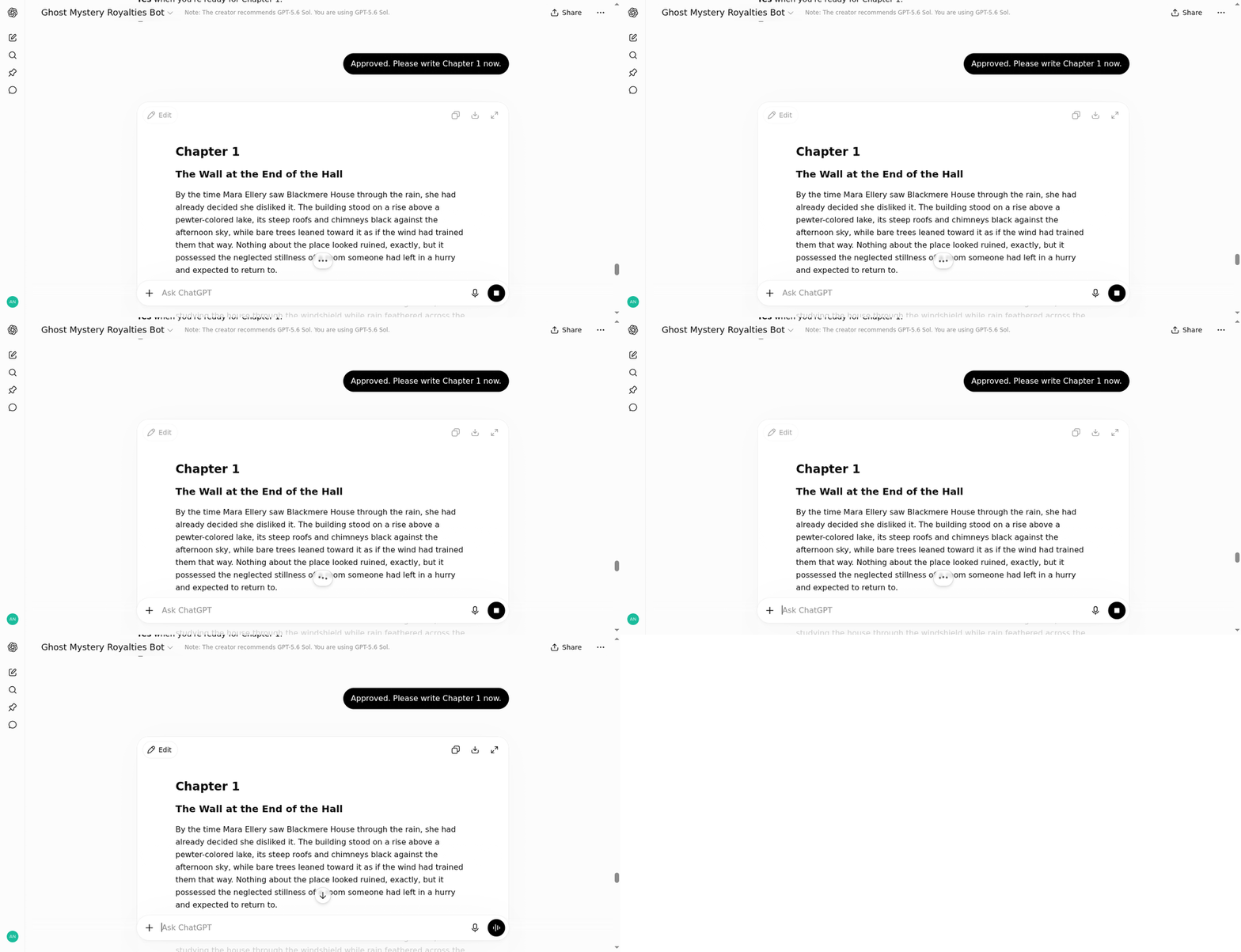

The blank page is a thing, and it’s probably the most prevalent cause of people quit on their novel writing endeavors. It’s quite a different thing to have an idea for a book than to know what exactly should go in chapter 9.
The division of the manuscript into chapters directly tackles that. You don’t ask one question to create an entire novel, but rather work on smaller, more manageable bits; revision is also easier because a weak chapter can be revised one at a time without having to fix an entire novel.
But AI-powered fiction isn’t exactly limitless. Some to look out for:
- The repetition of words or phrases throughout the chapters.
- Descriptions of scenes that would apply to any story.
- Any changes in continuity, names, timelines, or other details from chapter to chapter
- Story beats which may be anticipated and require human rewriting to feel fresh.
All of these are common features of other products. This is a common drawback of AI-written long narratives in general, and that’s why human involvement must be a regular part of the creation process.
Amazon KDP Keyword Generation
While not as sexy as some of the other aspects of publishing through KDP, keyword research is still relevant and important. The tool suggests 7 generic keywords that you could use as a starting point, depending on your book’s genre and premise.
Generally, there are only a few points to consider for keyword selection:
- How relevant the term actually is to your specific book
- What readers are searching for when they use that term
- How much competition exists for it
- Whether it’s specific enough to be useful rather than too broad
- Whether it fits your book’s actual genre and subject matter
Don’t use the suggestions you get as a definitive list of keywords to use, but as the starting point to check. Amazon’s back-end needs are dynamic, and a keyword which might’ve been logical a year ago may not meet the requirements today. The advantage of this is it is convenient: you’re beginning with seven ideas rather than a blank field, but the research responsibility hasn’t gone away.
Amazon Book Description Creation
The book description’s goal is to get people to click “buy” without revealing the conclusion of the book. When it’s a mystery, it’s typically about creating a situation that’s interesting, but you’re not telling the reader there’s a solution to the problem.
If you know your story thoroughly (and don’t necessarily have an ACTIVE imagination), then you can create a description based on your book premise and genre expectations, which is very valuable. A good description must have a clear ‘hook’ it into the reader in, must be easy to read, must have specific ‘genre signals’, and must have some open questions to keep the reader engaged.
The output of the generator should be edited by hand regardless of what it is. Before it steps onto your real Amazon page, double check character names, plot aspects, tone, and grammar. It’s better to have a generic description of an AI with a factual mistake than no description of an AI whatsoever.
AI Book Cover Generation
The cover tool is a feature of DALL-E that allows authors to brainstorm possible visual directions for their ghost or paranormal book, rather than beginning their work from scratch. That’s a good place to begin for brainstorming atmosphere, haunted settings, and character concepts.
There are some limitations that come with it, however.
- Typography sometimes requires further design efforts to make it look professional.
- Don’t expect to get it right the first time when you create visuals.
- A raw AI image might require some refinement before it can be used as a commercial cover.
It’s best to consider this as a creative sketchpad, and not a finished cover generator. Expect some follow-up editing (or handing it off to a designer) before it hits the web at Amazon.
Pen Name & Author Persona Generator
This is for those authors who wish to use a pen name that suits their genre and wouldn’t want to publish using their real name. It can come up with names and build out a cohesive author persona to accompany those names.
If you are establishing a brand around ghost and paranormal fiction and want to offer that as a service, then yes, that’s a fair calling card. What it cannot do is verify that the name is not taken elsewhere or that there are no trademark and branding issues. You should do some of that legwork before committing to a generated pen name.
Ease of Use
The greatest usability benefit of this is the guided structure. To get started as a beginner, you don’t need to know what to write in ChatGPT prompts right away, since the system will start asking questions and guide the project.
Dividing up a big project into smaller chunks also helps to alleviate the intimidation factor, particularly for the first time fiction writer. For more advanced KDP authors, it gets a little different: the benefit is not so much about hand-holding, but freeing up time spent on repetitive planning and prompt-writing.
Some tips on the learning curve:
- I’m finding it helpful that I’m already comfortable with ChatGPT.
- The workflow doesn’t require coding or technical setup.
- The staged format is a great deal as you are not left wondering what to do next most of the time.
Real Use Cases
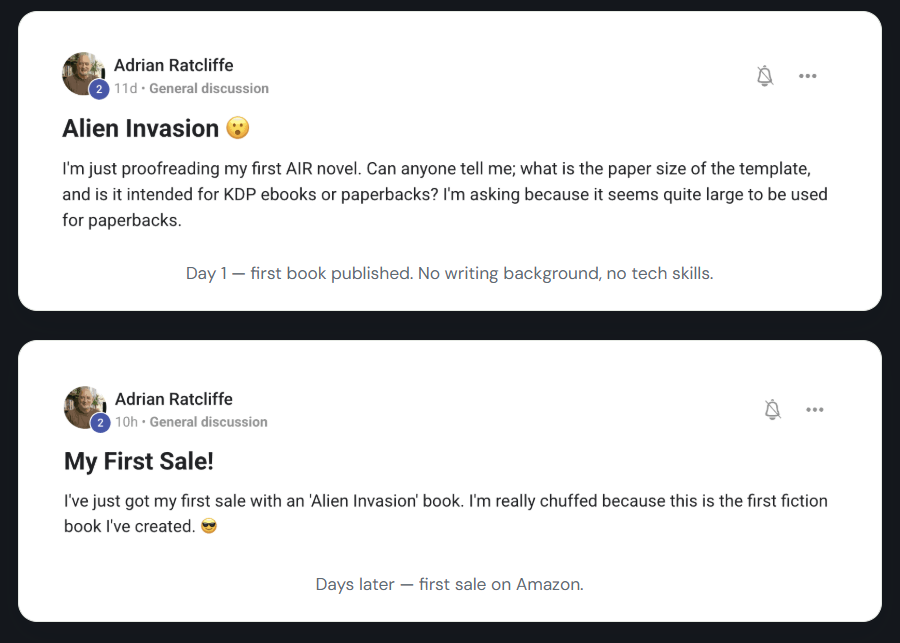
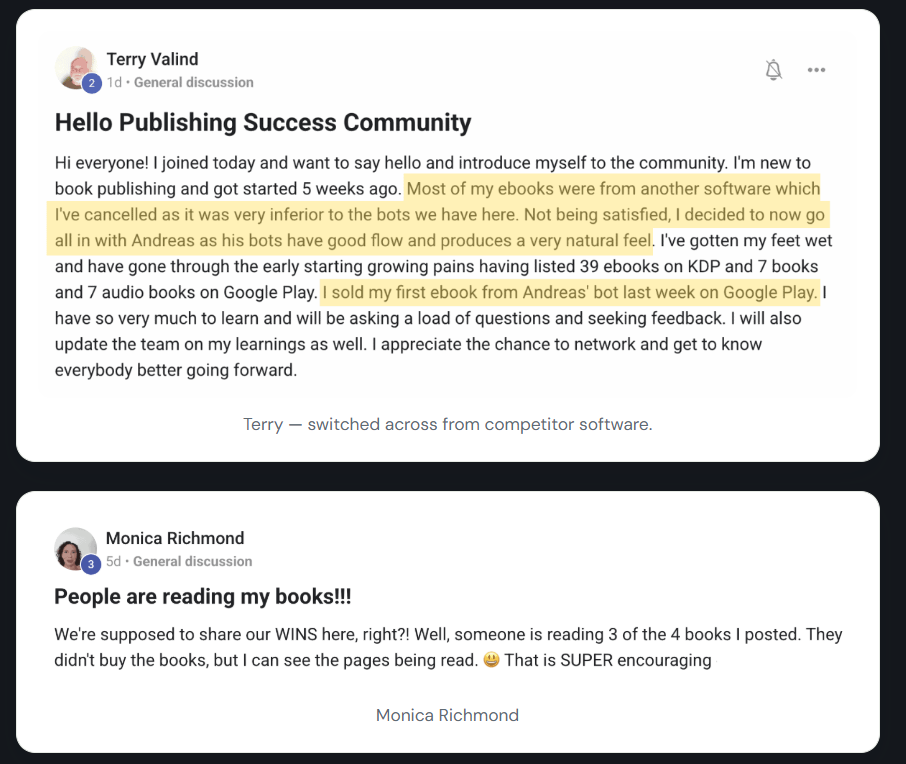
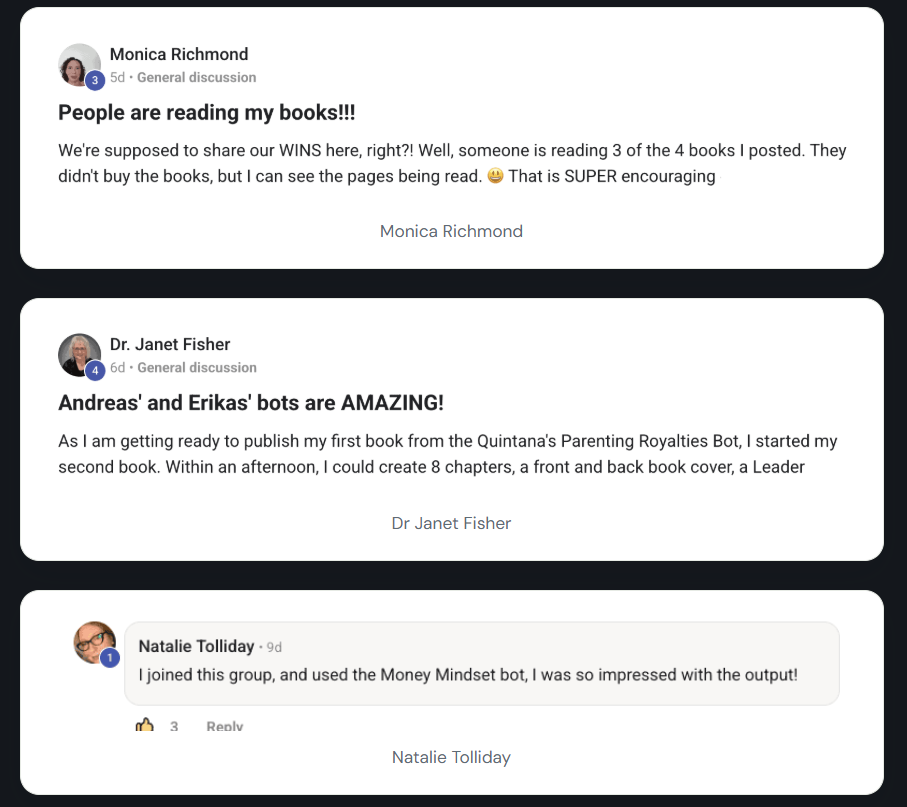
Here are some possible real-world applications of this workflow, without making any promises.
- Creating a concept for a paranormal mystery – Taking an unformed ghost story and building the concept into a firm premise.
- Creating a Story Bible – Securing the investigator, haunting, cast, and reveal prior to writing.
- Outline chapters – Not writing until you have a roadmap for your story chapter by chapter.
- Composing a Mystery Story – Generating a beginning draft in the chapter-by-chapter feature to edit.
- Research and narrow down keywords for KDP – Obtaining keywords and narrowing them down for KDP purposes.
- Making publications – Writing a book description, cover idea, pen name, author persona all in one.
These are real-life examples of the tool, and not sales rankings or income promises.
Output Quality
This is likely the most crucial section for anyone considering purchasing, as it is not just about the structure of the book–it’s about the book!
The originality of a story is much in the hands of what is put in. The tool magnifies your input, rather than doing the work for you, and vague, generic prompts generally lead to vague, generic responses. Character depth follows a similar pattern – they can come up with characteristics and backstories fairly easily, but convincing motivation will need a human pass to seem real.
In mystery stories, suspense is more important than probably any other genre of fiction, and pacing is everything. This has to be a series of clues that build up to a real surprise, not a series of spooky things. That is where using AI to create drafts can get the most reworked.
Another point that should be reviewed for consistency is across chapters. Relationships, timelines, names, and clues in their placement should all match up, and it should be verified manually, as it may not have been done correctly by the system.
The truthful critique: Don’t come to expect a finished manuscript – it is a first draft that will be polished. You wouldn’t consider it finished until you’ve done it to sound natural, original, in rhythm, and emotionally charged.
How Much Editing Is Required?
This is the most important factor to consider when deciding to buy a house. Getting a finished AI draft does not mean you get a publish-ready book, and treating it as such is the most frequent problem with tools such as this.
After applying the workflow, the following realistic editing jobs include:
- Developmental editing for clarity of overall story and character arcs
- Problems with contradictions between chapters were identified.
- Rewriting of weak and general sentences
- Fact-checking any factual references in the story
- Consistent prose throughout using style editing
- Proofreading – grammar, spelling, formatting
- An originality check prior to publication
- Quality Assurance on complete manuscript
This is none the less to say that this tool is not useless. It basically speeds up some parts of the process, such as planning, drafting structure, and publishing prep, but it doesn’t take away the editorial responsibility that you have when publishing a book with your name on the cover on Amazon.
Ghost Mystery / Paranormal Niche Focus
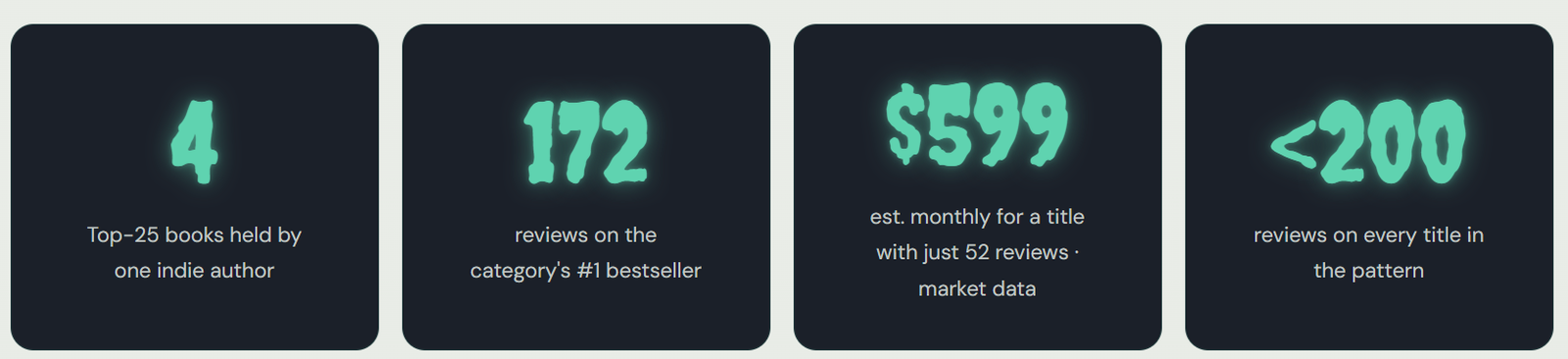
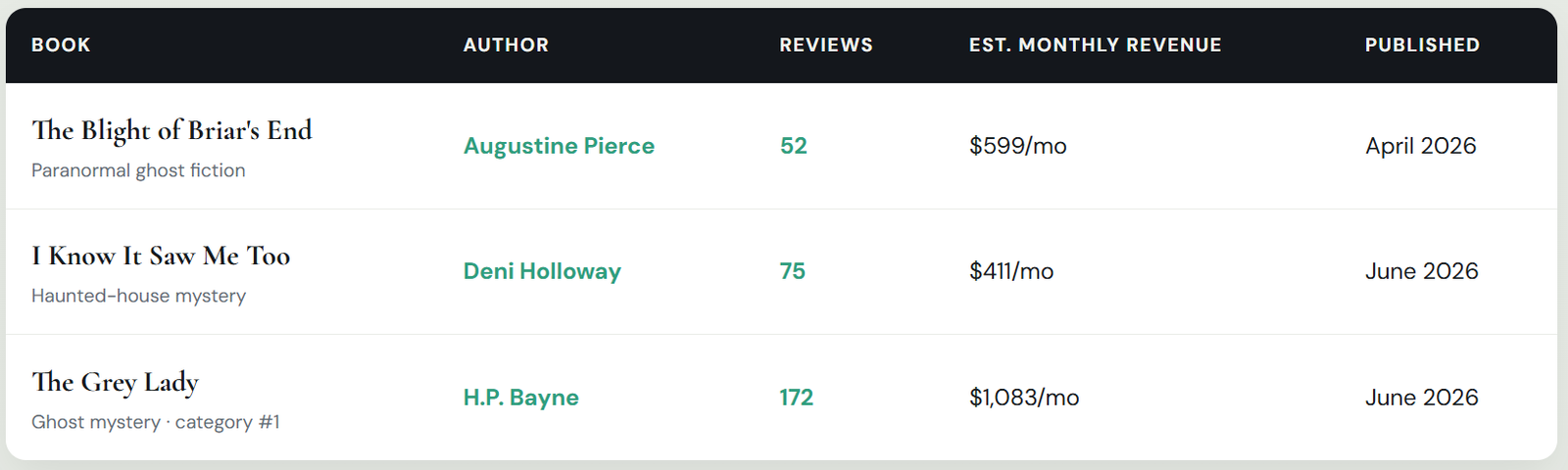


Specialization is the key feature of this product. It’s not just about fiction; it’s specifically about ghost, paranormal, and mystery fiction.
This is an actual benefit for an author already working in that area. Genre-specific guidance is more likely to yield results that are relevant in a supernatural mystery, ghost story, haunting, or an unexplained phenomenon, and will help you focus on the elements that are more important in this area of writing, as well as in other areas that you might be interested in, such as investigators and the clue-to-reveal chain.
Advantages of the specialty approach:
- More applicable text for paranormal fiction writers in particular
- Inherent mystery and supernatural elements in storytelling.
- Great for giving the structure for a book in a particular genre
Cons of the niche focus:
- Otherwise, it’s pretty useless if you write outside of this genre
- You will still need to tailor the created content to your own voice
- There is no correlation between genre specialization and good output
For romance, thriller, or historical fiction, this particular tool may not be the one you are looking for, despite the paranormal aspects of the work.
Pricing
Here’s what the numbers actually look like.
| Item | Price |
|---|---|
| Front-end product | $17.88 |
This is at the lower end for a workflow that includes story development, chapter drafting, KDP prep, cover generation, and author branding at $17.88. This obviously depends on the extent to which you actually use it, so it may not make good value if you’re not using it much.
A person who needs occasional brainstorming assistance will not use 50% of the features. An author who is looking to become a KDP writer is more apt to get their money’s worth when they have a real established system to follow that they can use to go from concept to publishing prep. In either case, this $17.88 is a good value when you consider what is actually included, and not on the assumption that purchasing the tool generates sales or royalties.
OTOs: What Are the Upgrades?
Like most products in this category, the front-end purchase comes with optional upsells.
OTO | Price | What It Adds |
100 Premium Ghost Mystery Prompts | $27 | Additional niche-specific prompts |
200 Premium Ghost Mystery Prompts | $37 | Larger prompt collection |
Publishing Success Accelerator (Monthly) | $38/month | Ongoing publishing-focused resource |
Publishing Success Accelerator (Yearly) | $380/year | Annual version of the same offer |
AI Sales Rocket | $97 | Additional AI sales-focused tools |
100 Premium Ghost Mystery Prompts ($27): Mainly relevant if you want a bigger library of niche-specific prompts to pull from. Not essential if the core workflow already covers what you need.
200 Premium Ghost Mystery Prompts ($37): A larger version of the same idea. Its value really comes down to how often you plan to experiment with different story concepts.
Publishing Success Accelerator, Monthly ($38/month): This one makes more sense for someone who wants an ongoing resource rather than a one-time purchase, and it’s worth thinking about whether you’ll actually use it month over month.
Publishing Success Accelerator, Yearly ($380/year): The annual version of the same offer. Only worth it if you’re confident you’ll use the material regularly across the year.
AI Sales Rocket ($97): Focused on sales-side tools rather than writing or publishing prep. More relevant to buyers who specifically want help beyond the manuscript and KDP assets.
None of these are required to use or understand the core Ghost Mystery Royalties Bot workflow. They’re add-ons, not prerequisites.
Pros and Cons
Pros
- Designed for ghost and paranormal mystery stories
- With guided structure, there is no blank page problem.
- In Story Bible stage planning before drafting begins.
- Chapter-by-chapter approach is helpful for longer projects of fiction.
- Contains keyword and description suggestions for KDP products
- Generates AI-based covers
- The Pen name and author persona tools provide an easy option to publish.
- No more than $17.88 to enter, for the amount of workflow provided.
Cons
- AI-generated fiction still needs real human review
- The quality of the output depends greatly on the inputs and revisions made.
- There may be continuity problems in longer manuscripts
- Prose created artificially will require stylistic editing.
- The keyword suggestions must be verified independently.
- Covers created using AI can require fine-tuning.
- If you write outside the ghost/mystery genre, then this isn’t useful.
What I Like
The workflow of this product is just the best. A first-time author may take a shot at a first concept and then plan the storyline and get to the point of writing the chapters without setting up a whole prompting system.
The Story Bible stage deserves praise as well. Putting some of the planning steps ahead of drafting, especially the clues, characters, and reveal, is a good thing because it is the only way mystery fiction will live or die based on its connection.
The “Bundling” of the KDP-related materials is also good practical sense. While keywords, descriptions, and covers are not writing, they are still necessary pieces of work to get a book ready for its publication and can be a source of some friction as they are packaged into the manuscript.
What I Don’t Like
This is not a unique issue of this product, but it’s important to reiterate again: AI written fiction still requires a human to do a lot of work and make sure it is of good quality and original, and consistent. It is not a process driven by a guided workflow, but rather it is driven by the author’s judgment.
It should also not be thought of as a total research tool. This is a beginning point, the requirements are subject to change at Amazon, so this is an independent check of what is actually there.
The AI cover tool is the same as that. While the generation of an image is easy, typography, composition, and final publishing specs will still necessitate additional work before a cover is truly ready for publishing.
Who Should Buy It?
This will work best for a fairly targeted group of authors.
- New KDP fiction authors looking for a framework rather than a blank page
- For writers of paranormal fiction seeking genre-specific AI help.
- Help for writers who must plan out clues, characters, and reveals in their mysteries.
- If you are an author who has a problem with planning a book in “long form” and require a Story Bible to be constructed, you will find this book to be the ideal reading partner.
- Authors who prefer to use a workflow rather than create their own prompts.
- Authors who wish to receive branding assistance.
- For anyone who desires publishing prep along with the manuscript work
Who Shouldn’t Buy It?
A few types of buyers probably won’t get much value here.
- Writers who want to write entirely without AI involvement
- Write in any genre that isn’t primarily ghost, paranormal, or mystery.
- Good writers with an established workflow that suits their needs
- Anyone expecting a publication-ready novel with no editing required
- Buyers hoping the software itself guarantees Amazon rankings, sales, or royalties
Is It Worth the Price?
Considering that the front-end price is $17.88, it’s not too expensive when you account for the fact that it’s planning a story, drafting a chapter, preparing the book for KDP, generating a cover, and author branding all in one place.
The organization is the main selling point, rather than the features themselves. If you already have a great prompt, then you may not learn much, but if you are a beginner, then you will reap the rewards of having it laid out for you step-by-step.
The editing requirement should also be taken into account. This isn’t a quick replacement for the time spent reviewing, rewriting, and proofreading before a book is ready for publication. This time is real and not to be overlooked when comparing the $17.88 price tag with what you’re receiving.
- Best value for: Authors genuinely interested in the paranormal/ghost mystery niche
- Good for beginners: Yes, mainly because of the guided structure
- Best feature: The staged story-to-manuscript process
- Main consideration: Human editing is still required
- Front-end value: Solid if you’ll actually use several parts of the workflow
If you are the right niche author, it is a respectable starting point of $17.88. It is a more difficult sell if you write outside of the genre you are aiming for or if you think that you are going to be able to produce a complete book without any editorial input.
Final Verdict
What Ghost Mystery Royalties Bot does best is to bring together the multiple steps of AI fiction writing, brainstorming, story planning, drafting, and KDP preparation, and run them together.
The most important thing to consider about it is that, like any AI fiction generator, it still requires a person to edit, continuity check and quality control the final product. The process is accelerated with the Workflow, but the author is still responsible for the book once it is finished.
- Main strength: A focused, structured AI writing workflow
- Main weakness: Requires real human editing before publishing
- Best audience: Ghost, paranormal, and mystery fiction authors
- Value for money: Good at the $17.88 entry price for the right user
- Overall recommendation: Worth considering if you want guided AI assistance for paranormal mystery writing and KDP prep, with realistic expectations about the editing still ahead of you
Here is the complete Ghost Mystery Royalties Bot Review: An obscure utility that performs one task fairly well – if you know what it does not.
Frequently Asked Questions
Ghost Mystery Royalties Bot is what?
A workflow powered by ChatGPT to create ghost and paranormal mystery books and some KDP-related content.
How does Ghost Mystery Royalties Bot work?
It follows a process of structuring, making of a Story Bible, and chapter-by-chapter drafting before finalizing the assets preparation for KDP.
Is there a way to do it with ChatGPT?
Yes, it’s meant to be used as the main interface within the ChatGPT environment.
Does Ghost Mystery Royalties Bot Target KDP Writers in particular?
Yes. It’s designed to be used as a publishing tool by Amazon KDP, such as the book description, cover design, keyword suggestions, and so on.
How much does Ghost Mystery Royalties Bot cost?
The verified price on the front end is $17.88. Other optional OTOs are available at an extra cost.
Does it create Amazon keywords?
Yes, it does generate 7 suggested backend keyword ideas which you need to take a look at and validate prior to publishing.
Can it write a description of this book for me?
You can write one that is loosely based on the premise and genre of your book, but you’ll need to make sure it is accurate and in the tone of your book before using it commercially.
Is it able to draw a book cover?
Yes, it’s an AI-assisted cover on DALL-E, but there will be some work to do, particularly typography, before it’s really ready for prime time.
Does it write an entire novel automatically?
No. It is designed to be chapter-by-chapter written, not a novel that will end with one shot; it’s still a need to get it reviewed and edited by the author.
How much editing will an AI-generated book actually need?
That depends, but at least you can be assured of continuity checking, re-writing, style editing, proofreading, and a quality pass.
Is it suitable for genres other than paranormal mystery?
Not really. It’s a strength in ghost, paranormal, and mystery fiction, so writers in other genres probably won’t find much use out of it.
Do the OTOs need to be?
No. They are optional add-ons, additional prompts, and publishing or sales materials, and the product itself can be assessed and utilized independently.