
This LitRPG AI review covers a tool made for one kind of writer. That writer wants to build LitRPG novels and series without juggling five different apps.
You’ll see what the software does, what each plan costs, and where it falls short. This is a feature-based review. It uses the product details from the vendor’s sales page. I haven’t run a hands-on test, so nothing here is a personal result.
What Is LitRPG AI?
LitRPG AI is an AI publishing studio for people who want to write LitRPG novels and progression fantasy series. It puts story planning, chapter writing, character tracking, and book files in one place.
So what is LitRPG? Picture a fantasy story where the hero can see stats. He or she earns experience points, unlocks skills, and moves up levels. The world runs on game rules. Readers get to watch the hero grow stronger.
That’s hard to write. You have to track skills, gear, levels, and money across many chapters. One slip can confuse readers. It gets worse when the story runs into a second or third book.
LitRPG AI tries to fix that problem. Based on the sales page, you pick a story style and a hero. You build a series plan, generate chapters, check game details, and prepare files for Amazon Kindle Direct Publishing (KDP). The tool also offers covers, book descriptions, author websites, and series planning.
Here’s an important point. The software helps you get a book ready. It doesn’t promise a great story. It doesn’t promise Amazon will approve the book. It doesn’t promise readers will buy it. You still make the creative calls and follow the publishing rules.

Who Created LitRPG AI?
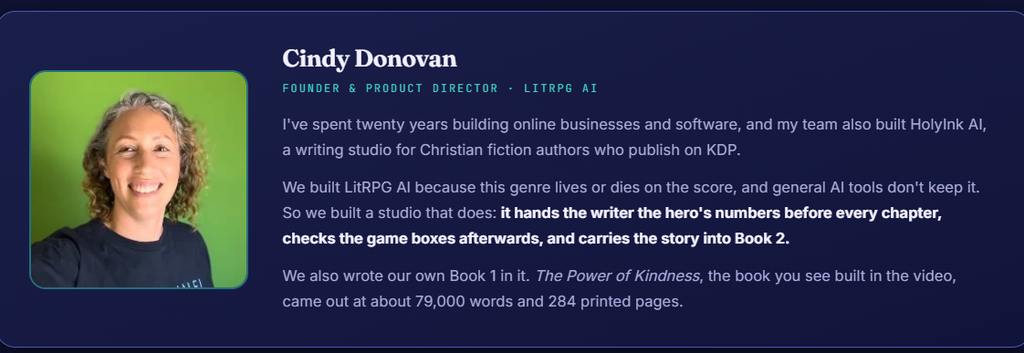
The sales page names Cindy Donovan as the founder and product director. It says she has more than 20 years of experience building online businesses and software.
The page also says her team worked on HolyInk AI. That’s a writing studio for Christian fiction authors.
This background matters a little. Her team has already built a guided writing tool for a fiction niche. But experience doesn’t prove that every feature works well. We can’t confirm any awards, outside endorsements, or other credentials, so we don’t claim any.
The vendor also shows sample books and early-tester comments. Treat those as vendor-made examples. They aren’t independent proof of what you’ll get.
Who Is LitRPG AI For?
LitRPG AI is made for people who want to write LitRPG and related fantasy. Here are the groups it may fit.
Beginners. Maybe you have a story idea but no plan for a long book. The guided setup and chapter plan can give you a start.
Authors planning a series. The tool is built to carry story facts from one book to the next. That helps if one hero will star in several books.
Amazon KDP self-publishers. The kit includes an EPUB, a paperback PDF, covers, and listing text. That may save you some steps.
Writers who like tracking stats. If your story has levels, skills, and gear, the running record could help.
Freelancers and ghostwriters. The Legend plan advertises a Publisher’s Licence. It’s meant for writing books for clients. Read the real licence terms before you sell anything.
Your results depend on your goals, your editing skills, your budget, and your willingness to review AI-written text.
One warning. This is niche software. If you write cookbooks or business guides, most of its tools won’t help you.
How Does LitRPG AI Work?
The studio uses a guided path. It moves from a story idea to a finished manuscript and publishing files. Here are the eight steps, based on the sales page.
Step 1: Pick the Story Feel
You choose a tone. The options include Cozy, Heroic, Comedic, Satirical, Dark, and Very Dark. You can also change how much game math shows up in the text.
Your decision: the mood and the amount of game detail.
Step 2: Choose a Hero
The studio shows hero cards with different backgrounds. You pick one, change the details, and name the hero.
Your decision: who the story follows. The software supplies the starting options.
Step 3: Build the Series Story Page
You can pick a suggested story idea or write your own. The story page holds the world, characters, places, game rules, and facts that must stay the same.
The tool can help fill gaps. Still, check that its ideas match your vision.
Step 4: Set Up the Book and Chapter Plan
Here you set the main story, characters, title, and chapter plan. You can review and edit the plan before any chapters are written.
Don’t rush this step. A weak plan leads to a weak book, even when the sentences look polished.
Step 5: Generate Chapters
In the front-end version, chapters are written one at a time. You read each draft and decide what to do next. The sales page says earlier drafts are kept and your own edits don’t use credits.
Step 6: Check Stats and Story Consistency
The studio keeps a running record of stats, skills, gear, and similar details. It also runs checks that flag some game-related mistakes.
These checks can help. They don’t replace proofreading or a real edit.
Step 7: Prepare Covers, Listing Info, and Files
The publishing section builds an EPUB, a paperback PDF, cover files, and listing text. You must check every file. You also submit the book through your own publishing account.
Step 8: Carry the Story into Book 2
The tool is built to carry over the last book’s ending, character facts, and open story threads. That cuts down on repeat setup.
Not every plan works the same way. The front-end plans use the chapter-by-chapter flow. The Pro upgrade is advertised as adding more automation. Don’t assume one click builds a whole book.
Key Features of LitRPG AI
Here’s what the tool offers, and what each feature means in real use.
Series Builder and Story Types
The sales page lists ten story types. Named examples include Dungeon Crawl, Craft and Trade, Build a Settlement, Play the Monster, Academy, Beast Taming, and Run a Guild.
That’s a good spread. One writer might want a classic dungeon story. Another might want a cozy shop where crafting makes the hero stronger.
A template gives you a starting shape. It doesn’t make the story original. You still need your own characters, problems, and settings.
Hero Cards and Character Setup
The studio offers nearly 60 hero cards. Examples include a veteran nurse, an experienced detective, a parent, a scholar, and a monster with surprising traits. You can edit details and choose a gender preference.
The main gain is speed. You don’t have to spend hours picking a lead. You pick one, then change what you don’t like.
Chapter-by-Chapter Writing
You review the chapter plan, then generate chapters one at a time. You can read each draft, edit it, and decide whether to move on.
This gives you more control than a one-shot book. It helps you catch problems early.
The trade-off is time. Anyone who expects a finished, ready-to-sell novel with no review will likely be let down. The Pro upgrade is advertised as adding more automatic steps.
Stats, Skills, and Continuity Tracking
This is the feature that matters most for the genre.
A LitRPG hero has health, mana, levels, skills, gear, and money. These numbers shape later scenes. Say the hero has 12 gold coins and then spends 25 with no new income. Readers notice. The same goes for using a skill before learning it.
LitRPG AI keeps a running score and checks game-related text for certain errors. The sales page says there are checks for 14 kinds of errors.
That sounds helpful for a number-heavy genre. But no checker finds every plot hole, weak line, or odd character choice. You still need to read the whole manuscript.
Book 2 and Series Continuation
A sequel needs more than the same hero. It needs new trouble and real growth.
The tool is built to carry over the ending, character details, and open conflicts. The sales page also mentions a check that flags sequel plans that repeat Book 1.
That’s handy. But software can’t tell you if your story is still fun. That judgment is yours.
KDP Publishing Kit
The kit gathers book files in one download. Per the sales page, it can include:
- An EPUB for ebooks.
- A paperback interior PDF.
- A full paperback cover wrap, with a spine sized to the page count.
- An ebook cover.
- Book listing information.
- A Word copy and a reading PDF.
Having these files together may save you from hopping between tools. Still, check every file before you upload. Formatting errors, cover problems, and wrong details can slip through. Amazon has its own rules, and a generated file doesn’t guarantee approval.
Pen Names and Author Websites
The front-end offer includes three pen names. Each one gets its own author website, according to the sales page. The studio also offers author-page designs and pages for single books.
That may suit someone who runs several series under different names. But a website won’t bring readers by itself. You still have to promote your books and keep the pages accurate.
Front-end limits are lower than the limits advertised for Pro.
LitRPG AI Demo: What You Get Inside
Look at the real interface before you buy anything. The sales page has a demo of the studio and its workflow. That demo is made by the vendor, so treat it as a showcase.
Here’s what to look for:
- Series setup: How are story styles, heroes, and story ideas shown?
- Story page and chapter plan: Can you read and edit them before writing starts?
- Writing room: How are drafts handled, and can you see the credit cost first?
- Consistency checks: What does the running stat record look like? What errors does it flag?
- Publishing section: Which files come in the download?
- Book 2 setup: How does the tool carry facts forward?
A demo shows how a feature should work. It doesn’t prove every buyer gets the same result.
We have not tested the software ourselves. This section is based on the sales page. Check the live demo and the current offer before you buy.
LitRPG AI Pricing and Plans
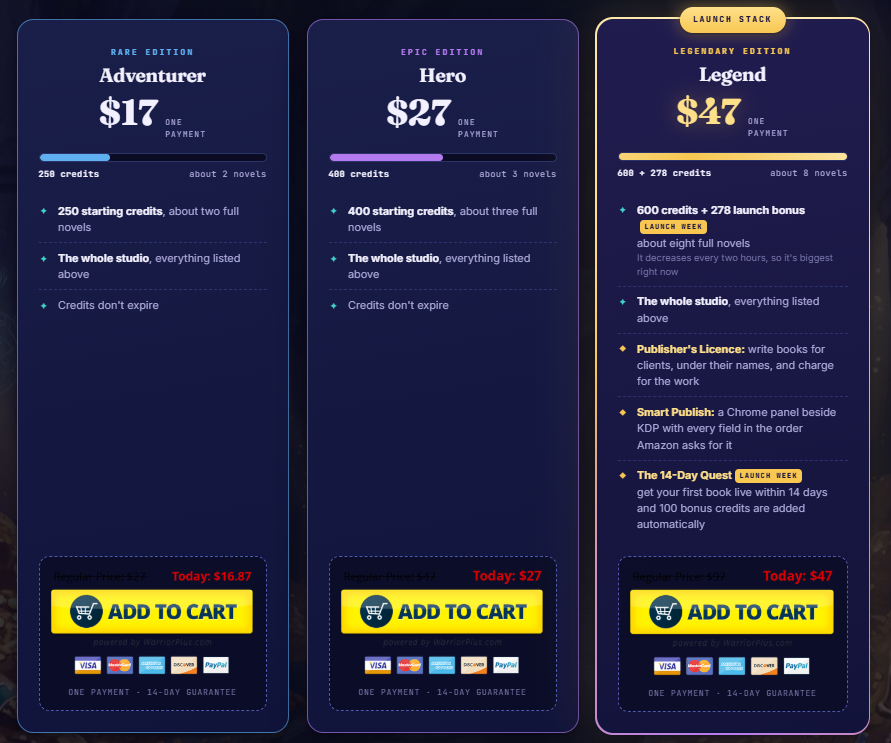
The launch offer lists three front-end plans. The big difference is the number of starting credits. The top plan also adds extras.
These numbers come from the supplied offer. Prices and bonuses can change, so confirm them at checkout.
Plan | Price | Starting Credits | Notable Extras |
Adventurer | $17 one-time | 250 | Entry-level access |
Hero | $27 one-time | 400 | Bigger credit pool |
Legend | $47 one-time | 600 base | Launch extras, where still available |
The vendor says a 30-chapter novel uses about 90 credits, from setup to finished cover. That’s an estimate. If you redo steps or regenerate text, you’ll use more.
Adventurer Plan
Adventurer costs $17 as a one-time payment. It comes with 250 starting credits.
It may suit you if you just want to try the studio. The credit limit caps how much you can make before you need more.
Ask yourself one thing. Do you want to test the tool, or do you want to produce several full books?
Hero Plan
Hero costs $27 as a one-time payment. It gives you 400 starting credits.
You get more room to work on a series or run more drafts. The price stays low. But more credits aren’t always better value. It depends on how much you plan to create.
Legend Plan
Legend costs $47 as a one-time payment. It has 600 base credits.
The launch offer also lists bonus credits, the Publisher’s Licence, Smart Publish, and the 14-Day Quest. Launch bonuses often have deadlines. Don’t assume they’re still open. Check the current page for the final credit total and what’s included.
Which Plan Fits You?
There’s no single best pick.
- Adventurer: a small first step to explore the workflow.
- Hero: more credits without the top price.
- Legend: the biggest front-end credit pool, plus the extras that are still on offer.
Compare price, credits, limits, and how much writing you’ll really do. Don’t pick a plan because of a claim about how many novels it can make.
LitRPG AI OTOs and Optional Upgrades
An OTO is a one-time offer. It’s an extra product shown during checkout. LitRPG AI has four of them, plus a bundle. None are required.
OTO 1: LitRPG AI Pro
The offer lists several Pro payment options. They include a monthly plan and annual or 12-month access. The terms differ, so read the checkout page closely.
Pro is for people who want more automation. The advertised features include:
- Automatic series-map creation.
- One-press book setup and chapter planning.
- An automated chapter-writing flow.
- Publishing help.
- Reader Steering, which uses QR-based reader votes.
- More or unlimited pen names, series, and books per series.
- Priority processing when the system is busy.
- 800 credits a month while your access stays active.
The big plus is convenience if you plan to write many books. The big question is the repeat cost. If you write one book slowly, the extra automation may not be worth it.
OTO 2: Audiobook Studio
This one is listed at $67. It helps you prepare a book for audio.
The advertised tools include:
- An audio script builder.
- Voice and tone notes for each character.
- A pronunciation guide for made-up names and terms.
- Training on narration and marketing.
- Tips on narrators and platforms.
Here’s the key limit. The sales page says in-app narration is not included at launch. The tool prepares material for a human narrator or an outside AI voice tool. It doesn’t create a finished audiobook for you.
If you only plan to sell ebooks, you can skip it.
OTO 3: Expansion Pass
This one is listed at $47. It helps you build products around a book or series.
The advertised tools include:
- A reader-revenue planner.
- Print-on-demand merchandise designs and listing text.
- Reader companions, character sheets, and glossaries.
- Box-set and omnibus tools.
- Backmatter and series sales pages.
A merch design or sales page doesn’t guarantee a sale. You still choose the products and find the buyers. This add-on fits writers who already have a series.
OTO 4: Fandom Forge
This one is listed at $67. It’s for promoting LitRPG books.
The advertised tools include:
- A 30-day social content calendar for each book.
- Short video scripts.
- Game-style achievement and level-up memes.
- Character reveal materials and art prompts.
- Audio clip scripts.
- Royal Road promotion tips and hashtag lists.
These can save planning time. But you still need to review posts, pick platforms, and post often. It may help if you hate making promo content. If you already have a marketing routine, you may not need it.
All Access Pass
The offer lists the All Access Pass at $197 for the first year, then $147 a year. It’s advertised as a bundle with Pro, the listed upgrades, and future quarterly releases while the pass stays active.
A bundle isn’t always cheaper for you. Compare it with the individual add-ons you’d really use. Also check the renewal price, the cancel terms, and what “future releases” covers.
If you’re new, the front-end plan is the safer way to test the workflow first.
LitRPG AI Review: Detailed Analysis
Writing a long LitRPG series takes more than typing paragraphs. You manage plot, characters, game systems, continuity, and book files. LitRPG AI tries to handle those jobs in one guided flow.
Here’s our take. It rests on the sales page and on common sense, not on hands-on tests.
Story Planning
Picking a story style and a hero before you write is a smart start. It should help beginners who have an idea but no structure. Being able to edit the chapter plan matters too, because you can fix problems before the full draft exists.
The quality still depends on your idea and your choices.
The Writing Flow
Chapter-by-chapter writing is a good middle ground. You get help, and you keep control. It’s slower than full automation. But slower also means you can fix weak spots as you go.
Whether Pro’s extra automation is worth paying for depends on your goals.
Consistency Tracking
The running score and game checks are the most distinctive part. In LitRPG, a wrong level or a missing item can break the spell. A tidy record could prevent a lot of those slips.
But a stat checker isn’t an editor. It may miss flat dialogue, repeated scenes, or big plot holes. You have to read the book.
Publishing Prep
A single kit with an EPUB, paperback PDF, and cover files could save time. Still, file prep isn’t the same as publishing success. Check every output.
Credits and Cost
The front-end prices are low next to many software subscriptions. The sales page says credit costs show before paid steps. That’s a good sign for transparency.
But regenerating and repeating steps eats credits. The novel counts you see in ads are estimates.
Overall Assessment
LitRPG AI looks built for authors who want a guided, genre-specific workflow. Its strengths on paper are story setup, stat tracking, chapter plans, the sequel flow, and publishing files.
Its limits are the need for human editing, the credit caps, the front-end project limits, and the cost of add-ons.
Because we haven’t tested it, we can’t confirm the writing quality, the stability, or the time you’d save. Use the demo and read the current terms first.
LitRPG AI Pros and Cons
Every tool has trade-offs. Here are the main ones.
Pros
- Made for LitRPG: The workflow fits game-style fiction.
- Guided setup: You start with a story style, a hero, and a series plan.
- Editable chapter plan: You can review it before writing begins.
- Stat and skill tracking: A running record covers stats, skills, and gear.
- Sequel support: It’s built to carry story facts into Book 2.
- Publishing files in one place: The kit gathers common ebook and paperback files.
- Author pages included: The front-end offer adds pen names and author websites.
- Visible credit costs: The vendor says prices show before paid steps.
- No separate ChatGPT plan needed: The sales page says AI access is built in.
Cons
- You still have to edit: AI text can be weak or repetitive.
- Credits are limited: Redoing steps can burn through them.
- Front-end limits apply: The offer limits pen names, series, and books per series.
- Pro can add repeat costs: The automated flow has its own payment options.
- No in-app narration: Audiobook Studio only prepares scripts and notes.
- No approval promise: Amazon may still reject a book.
- No sales promise: The tool can’t guarantee readers, rankings, or income.
- Claims aren’t tested: The demo and testimonials come from the vendor.
Who Gets the Most Value?
Someone who plans to write LitRPG often and will use the genre tools. A person with one short book may need only the basics. A person planning a big series may care more about continuity and automation.
Pick based on the work you’ll do, not on the length of the feature list.
LitRPG AI vs ChatGPT: Which Is Better?
Both can help you write. They do different jobs.
ChatGPT is a general AI assistant. It can brainstorm plots, draft scenes, build characters, and revise text. What it can do depends on the model, the tools, and how you use it.
LitRPG AI is a specialized studio. It walks you through a LitRPG publishing flow.
Area | LitRPG AI | ChatGPT |
Genre setup | Built for LitRPG | Needs your own instructions |
Story ideas | Story types and hero cards | Open brainstorming |
Chapter planning | Built into the studio | Can help make outlines |
Stat tracking | Running record with checks | You must set up your own method |
Continuity checks | Described game-error checks | Works if you feed it enough context |
Flexibility | Fixed workflow | Very flexible |
Publishing files | Dedicated KDP kit | Not a full publishing studio |
Pricing model | Credits plus optional upgrades | Depends on your plan and use |
Editing needed | Yes | Yes |
When LitRPG AI May Fit Better
It may be better if you want a guided path and built-in tools for stats and publishing. Everything sits in one place.
When ChatGPT May Fit Better
It may be better if you write in many genres. It also suits people who like to build their own workflow and manage notes, stats, and formatting by hand.
Which Should You Choose?
For a structured LitRPG process, LitRPG AI is worth a look. For flexible help across many writing jobs, ChatGPT may fit better.
Neither tool makes a hit book on its own. A fair test would give both the same task. Then compare the output, the consistency, the time, and the total cost.
Is LitRPG AI Easy to Use for Beginners?
It’s presented as beginner-friendly. The flow uses picture cards, suggested story ideas, and editable plans. That can help someone who has never written a LitRPG book.
You don’t need to be a gamer. Levels, skills, and stats are easy ideas.
But easy setup doesn’t mean easy writing. Beginners still have to learn how to shape a story, build real characters, and keep the plot tight. They also have to fix awkward lines, check spelling, and watch pacing.
Publishing adds more work. You check the cover and the interior files. You fill in the details. You follow platform rules, and you decide how to promote the book.
Think of LitRPG AI as a helper. It’s not a replacement for learning the craft.
Can You Publish AI-Written Books on Amazon KDP?
Amazon KDP allows books with AI-generated content. But it has rules about telling Amazon.
At a high level, KDP splits AI content into two groups. AI-generated content is text, images, or translations made by an AI tool. KDP asks you to disclose it when you publish a new book or edit and republish one. AI-assisted content is different. That’s when you wrote the work yourself and used AI to edit or improve it.
This matters for LitRPG AI. If the software writes your chapters or makes your cover art, treat that as AI-generated. Answer the KDP questions honestly.
You’re also responsible for following KDP’s content guidelines and respecting copyright. Before you upload, check the book for:
- Weak or repeated writing.
- Mixed-up characters or plot details.
- Copyright or trademark problems.
- Formatting errors or missing parts.
- A wrong title, author name, or description.
Amazon changes its rules from time to time. Read the current KDP Content Guidelines before you publish. Ready-made files don’t guarantee approval, and approval doesn’t guarantee sales.
Who Should Buy LitRPG AI?
It may be worth a look if you match one of these profiles.
- You want to write LitRPG or progression fantasy. The genre tools were built for you.
- You plan a series. Stat tracking and the sequel flow may help.
- You want one workflow. The KDP kit may cut down on tool-hopping.
- You’re a beginner. The guided setup gives you a start.
- You’re a freelancer exploring fiction work. Read the Publisher’s Licence terms first.
In every case, it makes the most sense when you have a clear writing goal and you’re ready to review the output. It’s not a path to guaranteed income or a bestseller.
Who Should Avoid LitRPG AI?
It’s not for everyone. You may want to skip it if you:
- Don’t write LitRPG. Most of the special tools won’t help.
- Like doing everything by hand. You may not need a studio.
- Want hands-free money. AI books don’t guarantee sales.
- Expect unlimited output on the entry plan. Credits and project limits apply.
- Have a tight budget. Count the time to learn the tool and any add-ons.
- Don’t want to edit. The manuscript needs review before it goes live.
You don’t need every feature in a product. Buy only when the core workflow solves a real problem for you.
LitRPG AI Refund Policy
The offer advertises a 14-day money-back guarantee. The sales page says you can try the studio, make books and files, and ask for a refund within that time. It also says you can keep what you made.
Confirm the current terms on the official checkout page. Look for:
- When the 14 days start.
- How to send a refund request.
- Which purchase the guarantee covers.
- Whether repeat subscriptions follow different rules.
- What happens to your access and credits after a refund.
Contact the vendor through the support channel listed on the official page. Save your order email. Don’t count on a refund until you’ve read the actual terms.
LitRPG AI Bonuses
The launch offer describes several bonuses tied to the Legend plan and the launch period:
- Extra launch credits: Bonus credits are advertised for Legend during launch.
- The 14-Day Quest: A bonus-credit reward for publishing a first book on Amazon within 14 days. Conditions apply.
- Publisher’s Licence: Permission to write books for clients under their names and charge for it, subject to the real licence terms.
- Smart Publish: A Chrome panel that helps you enter book details into KDP in the right order.
- Live series-building session: A live demo, with a replay for eligible launch buyers.
Some of these are launch incentives, not permanent features. Deadlines and credit amounts can change, and some may have ended. Confirm what’s still on offer before you count on any of them.
A bonus also doesn’t make a product the right fit. Judge the core workflow first.
Is LitRPG AI Worth It?
It depends on how you plan to use it.
For someone who writes LitRPG often, the mix of setup, planning, tracking, and publishing files may be useful. For someone who just wants help with a few scenes, a general AI tool may be enough.
Ask yourself:
Will you use the genre tools? If stats, game rules, and series continuity matter to your books, the focus is a plus.
How many books will you make? This sets how many credits and how much automation you need.
Are you OK with editing? You’ll need to improve the text and check every file.
Do you need the upgrades? Pro, Audiobook Studio, Expansion Pass, Fandom Forge, and the bundle solve different problems. You don’t need all of them.
Does the total cost fit? Count the entry price, repeat charges, credit use, and add-ons.
Our Take
LitRPG AI is worth checking out if you want to write LitRPG and like the idea of a guided, genre-specific workflow.
We wouldn’t buy it just because of promises about speed, royalties, or how hot the genre is. Look at the demo, check the plan limits, and confirm the refund terms. Then pick the lowest-cost plan that meets your needs, unless a bigger plan clearly earns its price.
The tool may help you stay organized. The book’s quality and sales are still up to you.
LitRPG AI Alternatives
You can write a fantasy series other ways.
General-Purpose AI Assistants
A general AI assistant can help with plots, characters, outlines, dialogue, and rewrites. It’s flexible and works for any genre.
The trade-off is that you build and keep your own notes, stat records, and continuity checks. You’ll likely need other software for publishing files.
Traditional Writing Software
Dedicated writing apps help you organize chapters, scenes, characters, and research. You keep full control, especially if you want to write the book yourself.
But they usually don’t write text for you, and they don’t have LitRPG-specific checks like the ones LitRPG AI describes.
Manual Writing and Publishing
Some authors write in a word processor, track stats in a spreadsheet, and make files with separate tools. This gives you the most freedom. It also takes the most manual work.
How to Choose
Compare tools by how you actually work, not by feature count. Think about writing quality, editing ease, continuity, publishing help, total cost, and manual effort.
If you can, test each option on the same small idea. Compare the outline, a sample chapter, the consistency, and the time you spend editing.
Frequently Asked Questions About LitRPG AI
What is LitRPG AI?
LitRPG AI is an AI publishing studio for planning, writing, and preparing LitRPG novels. The offer describes tools for chapters, character tracking, series continuity, and KDP files.
Who created LitRPG AI?
The sales page names Cindy Donovan as founder and product director. It says she has more than 20 years of experience building online businesses and software.
Does LitRPG AI write complete novels?
The front-end flow writes chapters one at a time, with planning and editing options. The Pro upgrade is advertised as adding more automatic steps. Review the manuscript before you publish.
Do I need a ChatGPT subscription?
No, according to the sales page. It says the AI is built in and needs no separate ChatGPT plan or API key.
How do LitRPG AI credits work?
Credits pay for certain steps in the studio. The vendor estimates about 90 credits for a 30-chapter novel, from setup to a finished cover. Redoing steps can use more.
Can beginners use LitRPG AI?
The studio has guided choices, story ideas, and chapter plans, so beginners may find it helpful. They still need to learn how to judge and edit their writing.
Can LitRPG AI prepare Amazon KDP files?
The sales page describes a kit with an EPUB, a paperback PDF, covers, and listing info. You must check the files and follow Amazon’s rules.
Does LitRPG AI include audiobook narration?
No. The sales page says Audiobook Studio prepares scripts, voice notes, pronunciation guides, and training. In-app narration isn’t included at launch.
Is LitRPG AI a one-time purchase?
The front-end plans are listed as one-time payments. Some upgrades, such as Pro and the All Access Pass, have repeat payment options. Check the checkout for exact terms.
Are Pro and the other upgrades optional?
Yes. They’re add-ons to the front-end studio. Their value depends on whether you need the extra automation, audio prep, reader products, or promo tools.
Does LitRPG AI guarantee book sales?
No. The tool can’t guarantee sales, rankings, royalties, reviews, or publishing success. Results depend on the book, its quality, its price, its promotion, and reader demand.
What is the LitRPG AI refund period?
The offer advertises a 14-day money-back guarantee. Read the current terms to see how it works and how to ask for a refund.
Final Verdict: Should You Buy LitRPG AI?
LitRPG AI is made for one audience. That’s authors who want help creating LitRPG novels and managing a series.
Its main appeal is the mix of story planning, chapter writing, stat tracking, sequel support, and publishing files. For writers who want more guidance than a general AI assistant gives, that may be useful.
The main concerns are credit limits, the need for human editing, front-end project limits, and the cost of upgrades. The tool also can’t promise that Amazon will accept a book or that it will earn money.
A Quick Decision Check
LitRPG AI may be worth exploring if you:
- Want to write LitRPG or progression fantasy.
- Plan a series, not a single short story.
- Need help with game details.
- Want help with ebook and paperback files.
- Are willing to review and improve AI-written text.
You may want other options if you:
- Write nonfiction or other genres.
- Prefer to control every step by hand.
- Expect hands-free income.
- Don’t want to edit AI text.
- Can’t justify the cost of a plan or its upgrades.
Final Recommendation
Based on the product information, this LitRPG AI review finds a specialized tool worth a close look for authors who want a structured LitRPG workflow. We haven’t tested the output ourselves. Treat the advertised features as a starting point, not proof of results.
Before you buy, watch the demo, confirm the current price and credits, read the refund terms, and decide if you really need any upgrades. If it fits your goals and your budget, you can look at the current offer below.
Ready to explore LitRPG AI?
👉Check the Current LitRPG AI Offer
Review the plan details, terms, and bonuses before you buy.